

Open source software stack for the development of robotic applications.
Office Address
Plaza de la Encina 10-11, Núcleo 4, 2ª Pl.
28760 Tres cantos - Madrid (España)

This use case demonstrates how the Vulcanexus CLOUD component with its ROS 2 Router (also known as DDS Router) enables the communication of two distributed ROS 2 networks based on DDS.
In the following video, you will discover how you set up a distributed deployment of a remotely controlled robot from the Cloud and use actions through ROS 2 Router.
The ROS 2 Router is an open-source software solution for geographically distributed ROS 2 networks and edge-cloud communication. That is, ROS 2 nodes, such as publishers and subscribers, or clients and services, deployed in one geographic location and using a dedicated local network will be able to communicate with ROS 2 nodes deployed in different geographic areas on their reliable local networks through the use of ROS 2 Router.
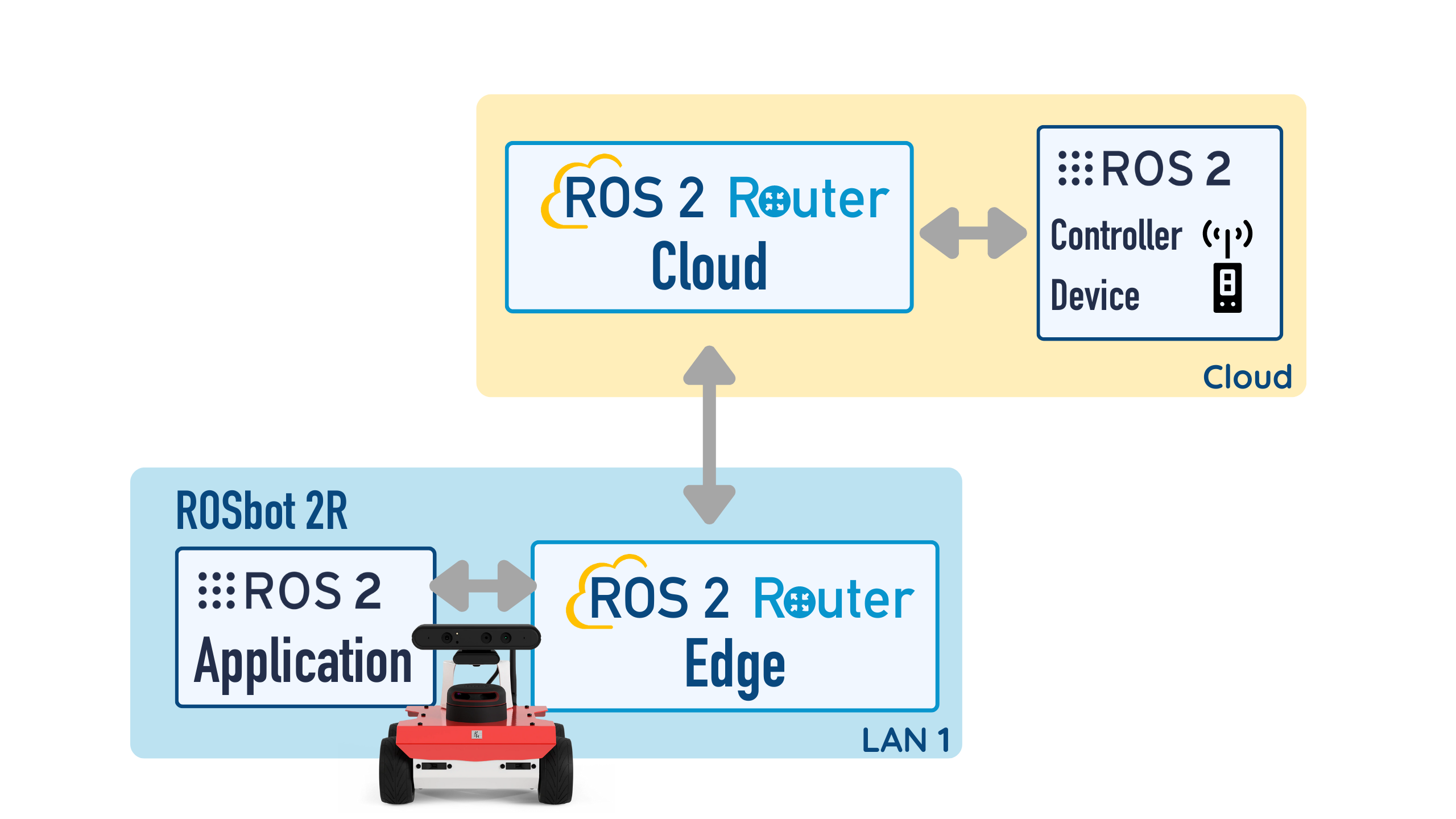
More specifically, this use case includes a controller device communicating through the cloud and the ROSbot 2R from Husarion through the edge.
The ROSbot 2R is an autonomous, open-source platform based on Raspberry Pi 4 that uses Vulcanexus components such as ROS 2 Router, is based on Ubuntu 20.04 operating system, and includes a set of tools to run ROS 2 nodes on Docker containers.
The video above shows the first steps to set up a basic edge-cloud architecture in which an edge robot is deployed on a Local Area Network (LAN) with access to the Internet, and a server in the Cloud reachable through the Internet.
The architecture is composed of two independent systems: a laptop running the controller and a ROS 2 Router on one side, and the ROSbot 2R running the navigation stack and another ROS 2 Router on the other side.
It is worth noting that each system is deployed in independent networks, and it is the ROS 2 Router that acts as an intermediate element that enables communication at each end through the Internet.
RViz is used as a controller deployed on a Cloud server that sends actions to the robot, deployed on the edge, to move to a given point. These actions are supported by the Navigation 2 package running on the robot. Thus, RViz invokes the NavigateToPose action defined in the Navigation 2 stack creating an action client. The robot, which deploys the action server, receives the command and starts moving towards the specified location. Eventually, the visualizer is informed that the robot has reached its destination by means of the feedback topic and the result service belonging to this ROS 2 action.
Please contact us.

Open source software stack for the development of robotic applications.
Plaza de la Encina 10-11, Núcleo 4, 2ª Pl.
28760 Tres cantos - Madrid (España)